Page 3 of 5
Re: Overtaking
Posted: Wed Dec 18, 2024 10:55 pm
by Cousin Jack
Roadcraft (spit!) suggests that when an overtake is imminent you should move up to a close following position. I don't think it suggests distances, but a car's length and a bit feels about right to me, so 5 -7 metres. If the overtake is not on I will drop back to 25-30 metres and wait a bit.
Re: Overtaking
Posted: Wed Dec 18, 2024 11:12 pm
by Horse
(Answering Wossname) No, I think drivers and riders are often unable to accurately judge speed and distance. Instead, from successful experience, they learn what 'ok' distances look like for speed.
They also forget, overlook, or never knew, rules of thumb like only 'planning to use a third of the distance' in case your doppelganger appears in the distance out of the blind bend.
A chap called Hills published some stuff which IIRC that overtaking over 50mph, against 50+mph traffic is beyond our abilities to judge accurately.
And, of course, for the distances involved, you need to be fairly sure that there are no other hazards along the way.
Re: Overtaking
Posted: Thu Dec 19, 2024 8:41 pm
by Scootabout
Makes me feel better about being a rider who passes on quite a few overtakes (see what I did there?).
Re: Overtaking
Posted: Mon Dec 23, 2024 6:46 pm
by the_priest
Line up, close eyes, pin throttle and pray!
More like, line up, check mirrors and road head and then make a "good progress" overtake when visibility is good and you can pull in once past in a safe manner. That is what I did being followed by le gendarme and apparently it was a "good overtake" and used the power of the bike to good effect, I did promptly return to signposted limits once I was past the said vehicle I passed (at close to warp factor 9).
Re: Overtaking
Posted: Tue Dec 24, 2024 10:40 pm
by Wossname
Right. The sprouts are on, just in time. I’ve done some sums.
V1=speed of him in car 5m long.
V2=speed of me on bike.
T=time needed to complete O/T.
D= distance “ “ “
60mph=27m/sec
Allow 2 secs following distance before and after.
So:
V1=55mph V2=60 (slow o/t) T=47sec, D=1270m.
V1=55,V2=65 (10mph diff) T=23sec, D=673m.
V1=55,V2=75 (20mph diff) T=12sec, D=405m.
V1=55,V2=85 (“flyin”) T=8sec, D=306m.
I think those times and distances are long enough to make you stop and think. Well, OK, just think then.
Must go -Santa will be along in a minute.
Happy Christmas!
Re: Overtaking
Posted: Thu Dec 26, 2024 9:34 pm
by Scootabout
Some might say you can reduce the distance by starting closer and moving in earlier, as @Cousin Jack said. Maybe to some degree, but, using the'flying' example:
- if you're doing the 'three stage' overtake, you'll be matching the speed of your target vehicle before moving out. So you'll be starting your overtake @55mph. You've then got to accelerate to a speed such that your *average* overtaking speed is 85mph. Challenging?
- if you take a 'run-up' you can achieve that 85mph average more easily, but it's an inherently higher risk approach, no?
So I actually wonder if 300m is close to the practical limit of the distance required to overtake a vehicle travelling at 55mph?
Re: Overtaking
Posted: Thu Dec 26, 2024 9:40 pm
by Cousin Jack
Scootabout wrote: Thu Dec 26, 2024 9:34 pm
Some might say you can reduce the distance by starting closer and moving in earlier, as @Cousin Jack said. Maybe to some degree, but, using the'flying' example:
- if you're doing the 'three stage' overtake, you'll be matching the speed of your target vehicle before moving out. So you'll be starting your overtake @55mph. You've then got to accelerate to a speed such that your *average* overtaking speed is 85mph. Challenging?
- if you take a 'run-up' you can achieve that 85mph average more easily, but it's an inherently higher risk approach, no?
So I actually wonder if 300m is close to the practical limit of the distance required to overtake a vehicle travelling at 55mph?
'Ave them on the brakes.
Re: Overtaking
Posted: Fri Dec 27, 2024 12:12 pm
by Horse
Scootabout wrote: Thu Dec 26, 2024 9:34 pm
- if you take a 'run-up' you can achieve that 85mph average more easily, but it's an inherently higher risk approach, no?
AKA 'momentum' overtake
Yes, increased risk from having to commit from further back.
That said, if you choose to follow closely* at the same speed for any length of time, that could alter the risk levels balance between the two types of overtake.
* IIRC police / Roadcraft have moved back (sic) from the closed-up 'contact' following position.
That said, if you took the diagrams very literally and scaled from a 2 second normal following distance, that contact position was
very close.
While I take CJ's point about being offset from the car, that assumes that:
- there's space to the offside (for example) to use without meeting an oncoming vehicle
- neither vehicle moved to obstruct that space
There is a sort of compromise between the two types, useful for overtaking on the exit from bends.
Position to gain a view beyond the vehicle, then start to get power on as the bend opens, using the view to guess whether the driver ahead might have other ideas.
Also, re following position. There is another theory - which always felt to me as a justification or excuse - called IIRC the 'triangle of death'

. Basically, imagine a no-go zone bordered by an angled line from the vehicle's rear offside corner back to the verge.
Final thought on close-up following, particular to the offside. For the driver it can appear threatening. And may mean greater attention on you, likely resulting in reduced attention on the road ahead, et seq.
Re: Overtaking
Posted: Fri Dec 27, 2024 12:24 pm
by iansoady
Horse wrote: Fri Dec 27, 2024 12:12 pm
Final thought on close-up following, particular to the offside. For the driver it can appear threatening. And may mean greater attention on you, likely resulting in reduced attention on the road ahead, et seq.
And consequently more risk of sudden panic braking etc as that driver suddenly sees something they'd missed due to concentrating on the following bike.
Somewhere in this thread it's suggested that 5 metres is a reasonable following close-up distance. Really? The length of a car, covered in about a fifth of a second. I don't think many of us could do anything in that time (even poise ready for Horse's jump).
Re: Overtaking
Posted: Fri Dec 27, 2024 12:33 pm
by Horse
This from the 1995 edition (first post-'blue book', first of the 'bloated' version).
Latest I have is 2006. Anyone have the current edition and is bored enough to check?
Anyway, compare the two diagrams. I really hope that some art ill-advised artistic licence was taken and they're not intended to be to scale.
.

- Screenshot_20241227-122932.png (450.11 KiB) Viewed 1141 times
Re: Overtaking
Posted: Fri Dec 27, 2024 12:36 pm
by Horse
Actually, a sub-jump is 'stand up and move your left out of the way'.
If you have any overlap with the car.
Good luck on reacting that quickly!
Re: Overtaking
Posted: Fri Dec 27, 2024 12:58 pm
by Horse
FYI
https://journals.sagepub.com/doi/abs/10.1068/p090183
Vision, Visibility, and Perception in Driving
Brian L HillsView all authors and affiliations
Volume 9, Issue 2
https://doi.org/10.1068/p090183
Abstract
Recent research is reviewed and its implications discussed. ‘On-the-Spot’ accident investigations have confirmed that errors of perception by the driver are a major contributory factor to accidents. However, the available evidence suggests that few of these are attributable to reduced or defective vision, since at best only a weak relationship has been found between a driver's level of vision (or visual performance) and his accident rate. A number of reasons for this general finding are considered, including driver compensation. For all drivers, the rapid fall in visual acuity with angular distance from the centre of vision presents particular problems, giving special significance to eye-movement patterns and the problems of visual search. Numerous physical and psychophysical restrictions on visibility could lead to the ‘looked, but failed to see’ type of accident, but their relative importance requires evaluation.
There is now much evidence that the driver is quite often operating beyond his visual or perceptual capabilities in a number of key driving situations, including overtaking, joining or crossing a high-speed road, and a number of nighttime situations. It is concluded that ‘expectancy’, based on experience in both the long and the short term, has a profound influence on driver perception and assessment of risk. For all drivers, serious errors of judgement from time to time would seem inevitable. In general, these do not lead to accidents because of, among other things, the safety margins added by the driver and adjustments made by other road users. Thus, despite his limitations and fallibilities, the average driver is involved in surprisingly few serious incidents, particularly in view of the rapid rate of decisionmaking that is required. However, the present accident rate should not be accepted as inevitable and various countermeasures are discussed.
Re: Overtaking
Posted: Fri Dec 27, 2024 3:43 pm
by Horse
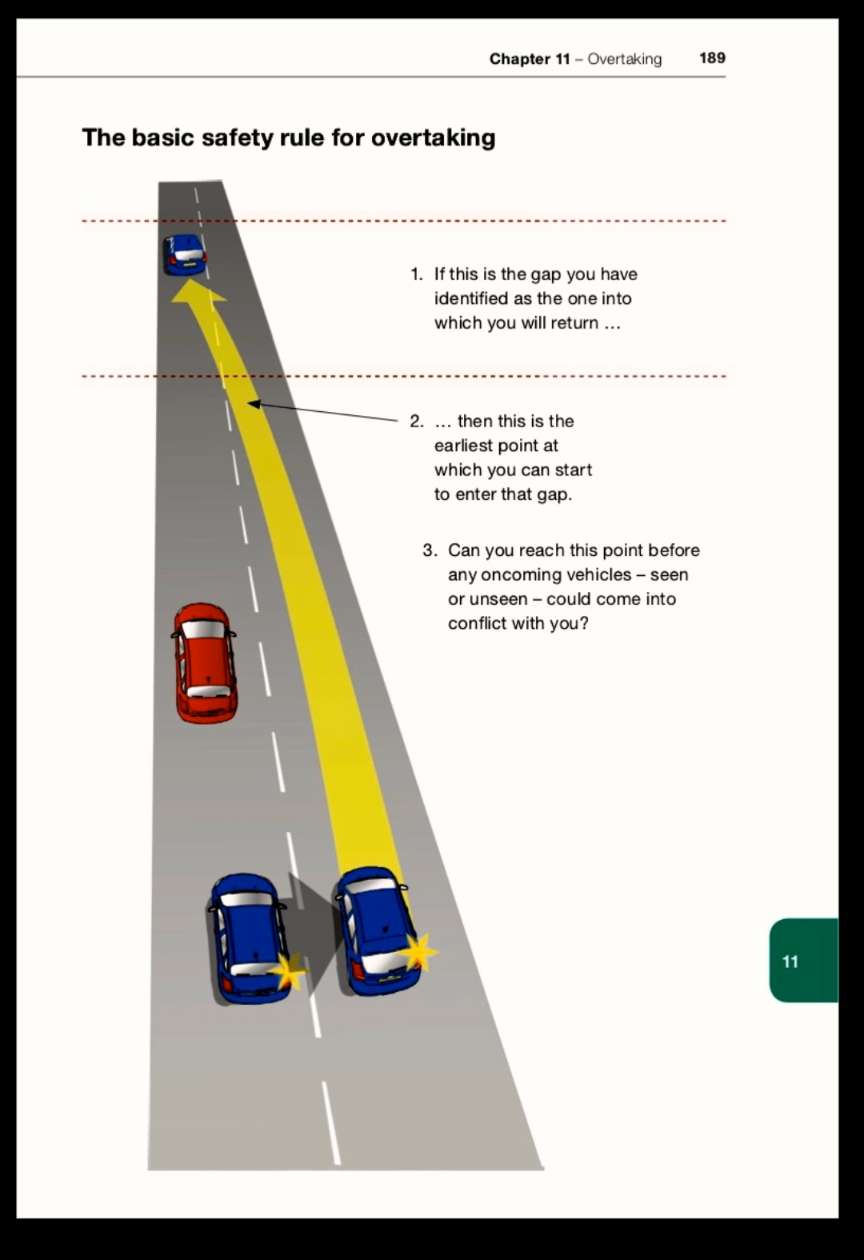
Trawling the Internet, found this diagram. Obviously from a later Rc than mine.
.
- Screenshot_20241227-151152.png (383.81 KiB) Viewed 1112 times
Again, I hope this is just artistic licence and they're not seriously suggesting a separation distance just over a car length. IIRC, TSRGD states, for a 50+ road, 6m lines with 3m spacing. So that scaling is all to pot.
[NB it appears that the advanced driver has decided to overtake on hazard lines too]
And this statement, which aligns with the 'safety is an emergent property' school of thought:..
The real problem is that it's not a guide to whether you can overtake safely but whether you HAVE overtaken safely - i.e. a retrospective test. I'm not sure that it is possible to try and measure the 'prospective' safety of an overtaking manoeuvre in this way.
Re: Overtaking
Posted: Sat Dec 28, 2024 7:58 pm
by Horse
With thanks to Mike Roberts
https://m.youtube.com/@mikeroberts/search
Here's the diagrams from the latest motorcycle edition.
Three stage - Titled 'Where other hazards require you to follow before you can safely overtake'
Momentum - That Roadcraft titles 'Where you are able to overtake immediately'
Looks like the follow/overtake distances for 'three stage' are more realistic (eg '2' & '1' seconds, or thereabouts).
.


Re: Overtaking
Posted: Sat Dec 28, 2024 8:00 pm
by Horse
NB but even with these we can be picky, for example moving out towards the centre requires that you're comfortable with what the oncoming driver will do.
Re: Overtaking
Posted: Sat Dec 28, 2024 8:48 pm
by Horse
Horse wrote: Fri Dec 27, 2024 12:12 pm
There is a sort of compromise between the two types, useful for overtaking on the exit from bends.
Position to gain a view beyond the vehicle, then start to get power on as the bend opens, using the view to guess whether the driver ahead might have other ideas.
Mike did a video on this.
I'd honestly not seen it until just now!
Re: Overtaking
Posted: Sat Dec 28, 2024 8:54 pm
by Rockburner
Just a thought, is it a possible idea to practise any of this on a safe environment like a dual carriageway way on a quiet morning? You can find a slow moving car, or even organise one, and find out just how long these overtakes take.
Re: Overtaking
Posted: Sat Dec 28, 2024 9:27 pm
by Horse
Rockburner wrote: Sat Dec 28, 2024 8:54 pm
Just a thought, is it a possible idea to practise any of this on a safe environment like a dual carriageway way
Yup, I've occasionally done that during training sessions.
Mind you, riding a K-RT made impersonating a car very easy

However, to be honest, it was for the procedure rather duration, with that probably coming as an experience / 'feel' thing.
Re: Overtaking
Posted: Mon Dec 30, 2024 8:13 am
by Dodgy69
Not read all the thread, but one thing I always remember is 'easy over the white line'. Whether accelerating or braking. Read somewhere once that the white line was probably a factor in a fatality a few years back. Slippy buggers sometimes.

Re: Overtaking
Posted: Mon Dec 30, 2024 9:24 am
by Horse
Dodgy69 wrote: Mon Dec 30, 2024 8:13 am
Not read all the thread, but one thing I always remember is 'easy over the white line'. Whether accelerating or braking. Read somewhere once that the white line was probably a factor in a fatality a few years back. Slippy buggers sometimes.
I think there's been a discussion here on that.
Essentially, if you need fractions of seconds that you're accelerating or braking hard enough when crossing the centre line, then it's probably a squeaky overtake.
