One thing I thought worth illustrating is how different ways of determining the maximum stopping distance (and so that limiting your speed) can appear.
At this point it's worth noting:
- if the bend radius decreases and you haven't allowed any margin for error, then you're over-riding the stopping distance that will be available
- stopping a bike while leant over is likely to need a longer distance than when upright and straight
- you ought to plan to stop within 'your' lane which, if you're riding out in a 'view' position, will be even more difficult as ideally as the bike slowed you would bring it straight and upright. The only way you could achieve that would be by initially turning tighter.
Roadcraft covers that with the 'stop on your side of the road ... between you and the limit point'. [2005 edition, I'm very happy to edit this if there's an improvement now]
It also says:
- 'It gives the point at which to start accelerating'
This referring to 'as the bend straightens your view begins to extend'.
New readers: the Limit Point (or limit of vision, or of visibility, or vanishing point) is:
- 'the furthest point ... uninterrupted view of the road surface'
Or:
- 'where the right hand side of the road appears to intersect with the left'
Think of the road ahead as an arrow head:
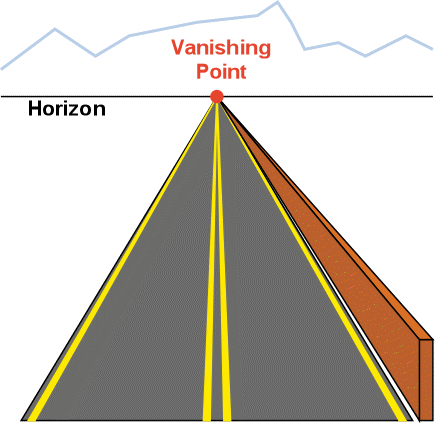
Fascinating trivia: on a level surface, that will always be at your eye height!
If the road curves away to the horizon, it will look like this:

The more acute the angle that the road edge is to the horizon, the tighter the bend.
As the point moves back towards a straight (running, to use one term), the bend is starting to open.
But can using the limit point lull you into a false sense of, well, not 'security', but 'comfort'? Especially if you're using it to determine stopping distance (and so your speed) and when to increase speed?
Regular readers will have heard the 'surprise horizon' mentioned. A term coined by Stephen Halley in his book Mind Driving, it's the closest point at which you can be surprised, ie you don't have a clear view.
Here's a bend, with a few gaudy lines added:

Bright red, intersecting with the hedge on the left, is the limit point.
Orange is how Roadcraft defines your stopping distance
Yellow is the surprise horizon
Dark red is your stopping distance to where something emerging could get you
Have a look at this pair of photos, from either side of the same bend:


The side turning - and, potentially, the Caterham - is invisible from even an extreme offside view. Which means you would be invisible to the driver.
NB photos taken on a closed road!
Here's another interesting road:

In traditional terms, see earlier quotes, the limit point is the crest of the bridge - but look how many blind side turnings there are (look for the wheelie bins).
SH info (book contents):
http://www.skilldriver.org/index.asp?pa ... .0.Welcome
Final thought: